Biathlon Betting: How Standing Shooting and Start Position Change an Athlete’s Chances
Biathlon betting becomes much easier to assess when a race is treated as a combination of skiing, shooting and race circumstances rather than as a simple comparison of names in the starting list. Two factors deserve particular attention in 2026: an athlete’s ability to shoot accurately from the standing position and the position from which that athlete begins the competition. Standing shooting often arrives when fatigue and pressure are already high, while start order can expose different competitors to changing snow, wind and track conditions. Their importance also changes between Sprint, Pursuit and Individual races. A strong skier can recover from some mistakes, but a costly standing miss or an unfavourable starting situation can alter the expected result quickly. For that reason, useful pre-race analysis should consider how the competition format converts misses into penalties, how consistently an athlete performs when standing and whether the starting position creates a meaningful advantage or disadvantage on that particular day.
Why Standing Shooting Can Change Biathlon Betting Probabilities
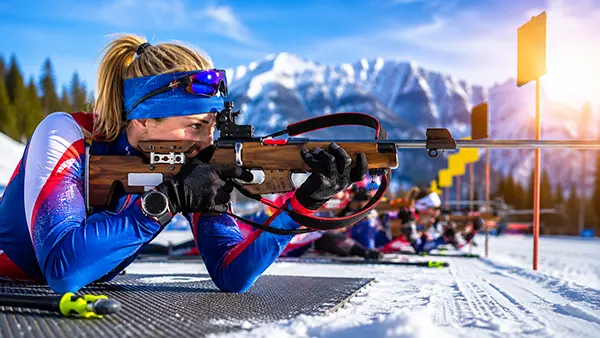
Standing shooting is one of the most important points of uncertainty in a biathlon race. Every shooting stage contains five targets at a distance of 50 metres. The standing target is larger than the prone target, but the athlete has much less physical support while aiming. Small body movements, breathing, wind and the effects of hard skiing can therefore influence the result. The statistical difference between two athletes may look modest over a full season, yet one additional miss can be decisive in a close race. Betting analysis should consequently separate standing and prone percentages instead of relying only on an athlete’s total shooting accuracy. A competitor who is extremely reliable while prone but noticeably weaker when standing has a different risk profile from an athlete whose overall percentage is similar but whose results are more balanced between the two positions.
The consequences are especially clear in the Sprint. Under current IBU rules, men race 10 km and women 7.5 km, starting at 30-second intervals. There are two shooting stages: prone first and standing second. Every missed target requires a 150-metre penalty loop. This makes the standing stage particularly influential because it comes late in a short competition. An athlete who reaches the range with a ten-second advantage can lose that advantage through a single miss and may have limited distance remaining to recover it. A fast skier with slightly weaker standing statistics can still be competitive, but the market price should reflect the possibility that skiing speed will have to compensate for additional time on the penalty loop.
The same shooting skill has a different value in other race formats. Pursuit and Mass Start competitions contain four stages in the order prone, prone, standing, standing, with a 150-metre loop for every miss. Two standing visits near the end of the race can therefore produce major changes in position after athletes have already skied several kilometres. The classic Individual is different again. It alternates prone and standing across four stages, but a missed target adds one full minute to the final time rather than sending the athlete around a standard 150-metre loop. A poor standing shooter may therefore carry substantially greater downside in an Individual than the same raw shooting percentage initially suggests. Race format should always be considered before translating a shooting statistic into an estimate of winning, podium or head-to-head probability.
How to Read Standing-Shooting Form Without Overreacting to One Race
Season-long standing accuracy provides a useful starting point, but it should not be treated as a complete prediction. Shooting percentages are based on a limited number of attempts, and short sequences can change the figures quickly. A better approach is to compare several layers of information: the current season, recent races and the athlete’s established level over previous seasons. If a normally reliable standing shooter misses repeatedly in one weekend, that does not automatically mean the underlying ability has disappeared. The opposite is also true. Two clean standing stages in a single race do not turn an inconsistent shooter into a low-risk selection. The important question is whether recent results form part of a genuine pattern or simply reflect normal variation in a sport where every shot has a large immediate consequence.
The 2025/26 World Cup season offers useful examples of why position-specific data matters. The IBU’s post-season shooting review listed Suvi Minkkinen at 92% in standing shooting, the highest figure among the women, while Johan-Olav Smoerdal Botn also finished at 92% standing and led the men’s field in that category. Such numbers provide more useful context than reputation alone. They show which athletes were repeatedly able to maintain accuracy without the support available in the prone position. At the same time, even a 92% rate still implies misses across a large enough sample. Strong historical accuracy should therefore increase confidence in an athlete’s shooting profile, not create an assumption that the next five targets will certainly fall.
Shooting speed should also be considered alongside accuracy. Two athletes can both clear five targets, yet one may leave the range several seconds earlier. The value of those seconds depends on the situation. A calm, slightly slower shooting routine may be a sensible trade-off in an Individual, where one miss costs a minute, while faster shooting can become more valuable in a Pursuit when several athletes arrive at the range together. Wind is another important variable. A competitor with excellent season statistics may face difficult gusts at the exact moment of shooting, while another athlete arrives during a calmer period. Pre-race betting should therefore use standing accuracy as evidence of long-term skill while leaving room for the environmental and competitive uncertainty of a specific race.
How Start Position Can Affect a Race Before the First Shooting Stage
Start position has different meanings across biathlon formats. In Sprint and Individual competitions, athletes race against the clock rather than beginning together. Current IBU discipline information specifies 30-second starting intervals. The number on a bib does not directly add or remove time from an athlete’s result, but it determines when that athlete encounters the course and shooting range. On a stable winter day, the difference between an early and a later start may be small. On a day with fresh snowfall, rising temperatures, strengthening wind or rapidly changing snow, the conditions experienced by the first starters may differ substantially from those encountered later. This is why start order deserves attention, but only together with the weather and course situation.
The IBU start-group system is also relevant when analysing World Cup Sprint and Individual races in 2026. Under the amended 2025/26 arrangement, the top 15 athletes in the current World Cup Total Score form the Red Group and athletes ranked 16–30 form the Blue Group. Other competitors are distributed through additional draw groups. In the normal sequence, leading athletes are spread further into the start list rather than automatically occupying the earliest numbers. The rule is designed around a structured draw rather than allowing every leading competitor to choose the most attractive starting time. For bettors, this means that a favourite’s later bib should not immediately be interpreted as negative. It first needs to be compared with the forecast and the likely development of the track.
The rules also recognise that start order can become a fairness issue when conditions are expected to change sharply. For 2025/26, IBU officials may use an alternative sequence in exceptional circumstances when the beginning, middle and end of a competition are likely to offer significantly different course conditions. This matters for race assessment because snow can become slower as temperatures rise, or a soft track can deteriorate after many athletes have passed over the same sections. Fresh snow can create the opposite problem for early starters if they have to ski through a less compact surface. Wind may also change during a race independently of the track. Start position is therefore best viewed as an environmental variable rather than a permanent advantage attached to either a low or high bib number.
Why Pursuit Start Gaps Are Different from Sprint Bib Numbers
The Pursuit requires a completely different interpretation of starting position. The top 60 athletes from the qualifying Sprint enter the race, and their starting times are based on their Sprint deficits. The Sprint winner leaves first. An athlete who finished 12 seconds behind starts the Pursuit 12 seconds later, while someone 55 seconds behind begins with approximately that gap to recover. This starting deficit is real race time, not merely an indication of order. As a result, the Sprint result effectively becomes part of the next competition. An athlete may have excellent Pursuit statistics and still face a difficult task if the preceding Sprint left a large gap to several strong rivals.
The size of the gap should be considered together with skiing speed and four-stage shooting ability. A 15-second deficit is often manageable for an athlete who is skiing strongly, particularly if the leader makes a mistake. A deficit close to a minute creates a much larger requirement for either superior skiing or errors from the athletes ahead. Standing shooting can transform that calculation late in the race. Because the final two range visits are standing stages, a leader who has protected a comfortable advantage through the first half of the race can lose much of it through one or two penalty loops. A chaser with reliable standing shooting may therefore have a better chance than the raw starting rank indicates, although the initial time gap must still be included in any realistic estimate.
Group behaviour adds another layer. Pursuit athletes frequently ski in packs after early gaps close, and this can change race tempo. A competitor starting alone may have to judge pace without direct comparison, while athletes in a group can see exactly where rivals are gaining or losing ground. However, following a group does not remove the need to shoot accurately. The range repeatedly separates athletes who arrived together. For live betting, this means the current physical order should not be read without checking how many shooting stages remain, which position will be used next and how many penalties each athlete has already accumulated. A racer sitting fifth before the final standing stage can still be in a stronger practical position than a second-placed athlete whose standing performance has been unstable.
Combining Shooting, Start Order and Ski Speed Before Placing a Bet
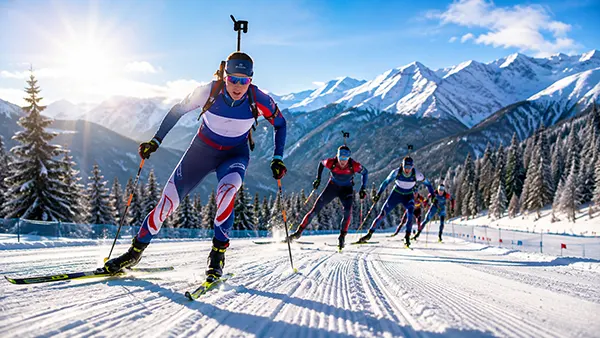
A useful biathlon assessment begins with the competition format and then adds athlete-specific information. In a Sprint, raw ski speed matters greatly because the course is short, but one standing miss can still erase a meaningful advantage. In a Pursuit, the starting deficit must be included before comparing athletes, followed by their ability across four shooting stages. In the Individual, shooting reliability receives greater weight because each miss produces a fixed one-minute penalty. This simple hierarchy prevents a common analytical mistake: applying the same athlete rating to every discipline. A biathlete can be an attractive Sprint contender because of exceptional course speed while carrying more risk in an Individual, where repeated misses are far harder to compensate for.
Recent ski form should then be compared with shooting form rather than blended into one vague impression. If an athlete is consistently among the fastest on course but has a standing percentage below the leading group, the question is how much time the skiing advantage can realistically recover after a miss. If another competitor skis slightly more slowly but regularly leaves the range clean, that profile may suit a head-to-head bet or a top-position market better than an outright-win market. Start order is the final adjustment in interval races. It can increase or reduce the value of an athlete when the forecast suggests changing conditions, but it should rarely overturn a large difference in underlying performance without clear evidence that the course will change substantially.
The betting market itself should influence how these factors are weighted. To win a World Cup race, an athlete normally needs a combination of strong skiing and competitive shooting because one weakness can be exposed by several elite rivals. A top-10 market allows more room for a conservative shooting profile even when outright winning speed is missing. Head-to-head bets require a direct comparison between two competitors, which can make position-specific shooting especially useful. If two athletes ski at a similar level but one has a clear and sustained advantage in standing accuracy, that difference may be more relevant than their overall World Cup ranking. No single statistic should be used in isolation, and historical data should be treated as evidence about probability rather than a guarantee of the next result.
A Practical Pre-Race Checklist for Biathlon Betting in 2026
The first step before a race is to separate prone and standing shooting data. Check the athlete’s season percentage, then compare it with a recent sample and the longer-term record when enough information is available. Look at how many penalties came in recent Sprints, Pursuits or Individuals rather than relying only on finishing positions. A low finish caused by slow skiing is different from a low finish caused by three standing misses. The same principle applies to a podium result: a strong finish produced by unusually perfect shooting may not be as repeatable as one supported by both good ski speed and an established accuracy level. The aim is to understand why recent results happened before assuming they will continue.
The second step is to check the official start list and the expected conditions close to race time. In Sprint and Individual events, note where the main contenders are positioned in the draw and whether temperatures, snowfall or wind are expected to change during the competition. Start numbers become much more meaningful when there is a credible reason for the course or range to change between groups. It is also worth confirming whether officials have announced an alternative start-group sequence because of difficult snow conditions. In a Pursuit, replace the bib-number question with the actual time deficits from the Sprint and calculate how much ground each athlete needs to recover before considering the shooting stages.
The final step is to keep uncertainty visible in the decision. Biathlon contains several independent sources of variation: ski form, wax performance, wind, shooting execution, traffic on the course and tactical choices. Even the athlete with the strongest statistics can miss targets or have an unexpectedly poor skiing day. Betting stakes should therefore be based on a predefined budget rather than increased because a selection appears certain. Comparing standing shooting, start position and ski speed can improve the quality of an assessment, but it cannot remove randomness from the event. The most useful 2026 approach is to judge probabilities from verifiable data, adjust them for race-specific circumstances and avoid treating any individual factor as a guaranteed predictor of the final order.