Curling: How the Hammer, Blank Ends and Ice Conditions Shape a Match
Curling is a sport in which the scoreboard often reveals only part of the competitive picture. A team trailing by one point may be in a stronger tactical position than its opponent, while an end that finishes without either side scoring can represent a successful strategic decision. Much depends on three interconnected factors: the right to deliver the last stone, commonly known as the hammer, the management of blank ends and the changing condition of the ice. Understanding these elements helps explain why teams sometimes avoid scoring, deliberately remove their own stones or adjust their approach halfway through a match. These details are particularly relevant when following international curling competitions in 2026, interpreting match statistics and assessing the context behind sports betting markets.
The Hammer in Curling and Its Strategic Importance
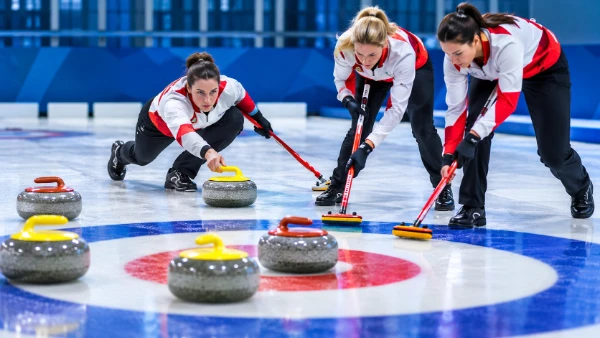
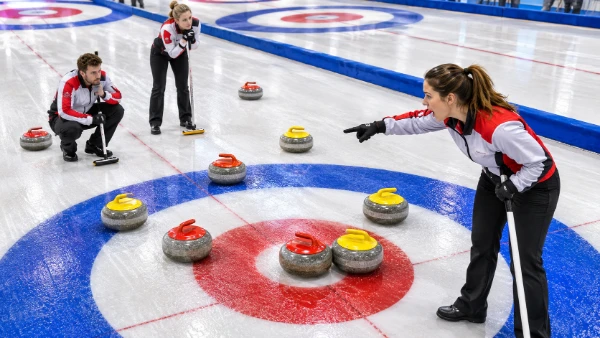
In traditional four-player curling, each team delivers eight granite stones per end, alternating with its opponent. The objective is to position stones closer to the centre of the house than the opposition’s nearest stone. The team delivering the final stone has the hammer, a significant advantage because it can respond to the opponent’s completed position without facing another immediate reply. A precise final delivery may remove a scoring stone, place an additional stone inside the house or turn a potentially unsuccessful end into a productive one. However, possession of the hammer does not guarantee that a team will score. Its value depends on the arrangement of stones, the available delivery paths and the accuracy of the players throughout the end.
At major international competitions, the initial last-stone advantage is generally determined through the Last Stone Draw before the match. Players deliver stones towards the centre of the house, and their accuracy is measured according to competition rules. Once the match begins, the hammer normally passes to the opposing team after a side scores. When a team scores without possessing the hammer, the result is known as a steal. This distinction is important because a stolen point changes the scoreboard without transferring the last-stone advantage to the team that scored. The side that conceded the steal retains the opportunity to respond in the following end, although its tactical options may become more restricted as the match progresses.
Teams with the hammer generally aim to collect at least two points when the circumstances permit. Scoring a single point means surrendering the last-stone advantage in exchange for a relatively small improvement on the scoreboard. By contrast, converting the hammer into two or three points creates a more substantial advantage. Teams playing without it often attempt to force their opponents to settle for one point rather than allowing an unrestricted attacking position. This explains why two teams with similar shooting accuracy can achieve different results. One may consistently convert possession of the hammer into multiple points, while the other struggles to develop scoring opportunities despite delivering technically sound individual shots.
How the Last-Stone Advantage Changes During a Match
The tactical value of the hammer increases or decreases according to the score and the number of remaining ends. Consider a ten-end match in which a team trails 4–5 after eight ends but has the hammer in the ninth. Scoring two points would establish a 6–5 lead, although the opposition would receive the final stone in the tenth. Scoring just one would level the match while handing the opponent a considerable opportunity to secure victory. The same hammer that appeared valuable at the beginning of the ninth end therefore presents a more complicated decision when viewed alongside the remaining playing time.
The free guard zone also influences how teams develop their last-stone opportunities. Under World Curling’s 2026 rules, opposing guards positioned within this protected area cannot be removed from play before the sixth stone of an end is delivered. The no-tick rule provides additional protection for qualifying opposing guards touching the centre line during this opening phase. These restrictions make it harder for a defending team to eliminate every obstacle immediately. A well-positioned guard can protect a scoring stone, restrict access to the button and complicate the opponent’s final delivery. Conversely, inaccurate guard placement may leave enough space for a relatively straightforward takeout or draw.
When following professional curling, it is worth distinguishing between possession of the hammer and effective use of it. A team may repeatedly enter ends with last-stone advantage but finish with only single points because its opponent controls the centre of the house. Another side may create favourable angles early, maintain accessible delivery routes and leave its final player with several realistic scoring options. Statistics such as points scored with the hammer, frequency of steals and forced single-point ends provide additional context beyond overall shooting percentages. Nevertheless, these figures describe previous performances rather than guaranteeing how an individual end or future match will finish.
Why Blank Ends Are an Important Part of Curling Strategy
A blank end occurs when neither team receives a point. In conventional four-player curling, a deliberately blanked end usually allows the team holding the hammer to retain it for the next end. This makes a scoreless passage of play fundamentally different from a missed scoring opportunity in many other sports. A team that cannot realistically collect multiple points may prefer to clear the house rather than accept one point and surrender its advantage. The decision is particularly common when the scoreboard remains close and enough ends are available to develop a more favourable attacking position. A blank end can therefore reflect controlled decision-making rather than a lack of competitive ambition.
Producing a deliberate blank is not necessarily straightforward. The team must remove opposing scoring stones while avoiding leaving one of its own stones inside or touching the house. A final takeout in which the delivered stone also rolls out of the scoring area is a familiar way of achieving this result. The opponent may attempt to prevent such an outcome by placing stones in positions that are difficult to remove cleanly. A stone partially protected by a guard, for example, can force the hammer-holding team to attempt a more demanding shot. If that shot fails, the intended blank may become an unwanted single-point score or even a steal for the opposition.
The usefulness of blank ends depends heavily on the competition format. Major men’s and women’s international championships generally use ten-end matches, while various other competitions operate over eight ends. Fewer scheduled ends reduce the number of opportunities available to recover from unsuccessful attacking decisions. Mixed doubles curling, which featured at the Milano Cortina 2026 Olympic Winter Games, operates differently again. In that discipline, a blank end results in the last-stone advantage changing sides. Consequently, the familiar four-player strategy of deliberately blanking an end to preserve the hammer cannot be applied to mixed doubles in the same manner.
When a Scoreless End Benefits One Team More Than the Other
Blank ends can become especially influential towards the closing stages of a match. Suppose a team leads 6–5 after eight ends and holds the hammer in the ninth. If it successfully blanks that end, it enters the tenth with both a one-point advantage and the right to deliver the final stone. Its opponent must then create a scoring opportunity without the hammer. For the trailing side, preventing the blank may be strategically important because forcing a single point would transfer the last-stone advantage for the final end. The absence of scoring in the ninth end could therefore substantially improve the leading team’s position.
The situation changes when the team with the hammer is behind by several points. Repeatedly blanking ends consumes the remaining opportunities to reduce the deficit, even though the team technically retains its last-stone advantage. A side trailing 3–6 after seven ends cannot approach the remaining play in the same way as a team protecting a narrow lead. It may need to accept greater tactical risk, introduce more guards and maintain several stones in scoring positions. Under these circumstances, an unsuccessful aggressive end can be costly, but continually avoiding scoring may leave insufficient time to recover. The scoreboard determines whether retaining the hammer remains useful.
For spectators interpreting match totals or end-by-end betting markets, blank ends also explain why scoring patterns are rarely uniform. A match may produce several points in its opening stages before entering a more conservative period. Equally, a low-scoring first half may be followed by more complicated ends when a trailing team has to increase the pressure. Simply calculating the average number of points scored per end does not account for these changing priorities. Betting settlement rules may also differ in their treatment of extra ends and early concessions, so the final sporting result and the settlement of a particular wager should not automatically be treated as identical.
How Ice Conditions Influence Stone Movement and Match Development
Unlike the smooth surface associated with speed skating, curling ice is deliberately prepared with a fine texture created by small frozen water droplets, commonly called pebble. The stone travels across this prepared surface on a narrow contact area underneath its base. Its movement is influenced by the speed of delivery, rotation, friction and the condition of the ice along its chosen path. Players must therefore judge both the required distance and the degree of sideways movement, known as curl. Even a well-executed delivery can finish outside its intended position if the team’s understanding of the playing surface is inaccurate.
Ice conditions are not necessarily identical across an entire curling sheet. Frequently used delivery routes may behave differently from less-used sections, while the condition of the pebble can change as a match progresses. Temperature, humidity, surface preparation and frost may also influence how consistently stones travel. Players use the term fast ice when stones require comparatively less delivery effort to reach their target, while slower ice demands a heavier delivery. The amount of curl is a separate consideration: fast ice does not automatically mean that stones will travel straighter or bend more sharply. Teams must assess these characteristics independently and adjust their communication accordingly.
Sweeping gives players an additional means of influencing a moving stone. Effective brushing can help it travel further and reduce unwanted sideways movement, depending on the delivery and ice conditions. In January 2026, World Curling introduced a Sweeping Technique Policy clarifying acceptable brushing practices and prohibiting techniques intended to increase a stone’s rate of deceleration. The policy is relevant to competitive analysis because not every physical method of influencing stone movement is permitted. Within the rules, sweepers must still make rapid judgements about speed, direction and the developing position of other stones. Their decisions can determine whether a delivery stops short of the house, reaches its intended location or travels beyond the scoring area.
Recognising Ice Changes and Their Effect on Competitive Performance
Experienced curling teams continuously gather information from previous deliveries. If several stones finish beyond the intended target despite apparently controlled releases, players may reconsider their assessment of ice speed. Similarly, a series of shots curling more sharply than expected can indicate that the chosen delivery line requires adjustment. Players communicate these observations to their teammates rather than treating each unsuccessful delivery as an isolated technical mistake. However, one unusual shot is not sufficient evidence of a change in the ice. Differences between individual stones, inconsistent releases and variations in sweeping can produce similar outcomes.
Changing ice conditions become particularly significant when teams attempt delicate draws, freezes or precise takeouts late in an end. A draw must stop in a specific scoring position, whereas a freeze places the delivered stone immediately against another stone. Small inaccuracies can leave an opponent with an accessible removal shot or prevent the attacking team from creating the necessary protection. In a crowded house, even a minor difference in the final position of a stone may determine whether the hammer produces multiple points or none. Teams that recognise changing conditions early can adjust their deliveries, but uncertainty remains whenever a less familiar section of the sheet must be used.
A meaningful assessment of a curling match therefore requires more than comparing team rankings or reading the current score. The remaining ends, possession of the hammer, arrangement of guards, frequency of blank ends and consistency of stone movement all help explain the decisions made on the ice. These factors should be considered together rather than used as independent predictors. A team may have the final stone and a favourable scoreboard but still face a difficult delivery on an unfamiliar line. Understanding these relationships provides a more accurate interpretation of competitive curling in 2026, while recognising that tactical advantages, historical statistics and observable ice conditions cannot eliminate uncertainty or guarantee a sporting or betting outcome.